
While blogs are primarily text they can feature videos, photos, graphic organizers, music, podcasts, and many other Web 2.0 tools. Blogs provide a platform, a voice, and an audience to anyone who has an idea and wishes to express it. Blogs are readily accessible online and are hosted by both free and paid providers.
Why Use Blogs in the Classroom?
An Interactive Community – serves as an extension of the classroom and offers users a platform in which they interact and have discussions with all members of the classroom community including students, teachers, administrators, and perhaps others on the world wide web. This interaction serves as a conversation in which students share research and opinions of topics while also learning from the comments and perspectives of other students.
An Authentic Audience – unlike the common term paper or essay in which students are writing for a one person audience (teacher), blogs provide users with a genuine audience of peers who are reading and responding to individual posts. This genuine audience gives students a purpose to their writing and they will work to improve their ideas and responses based upon peer evaluations and comments.
An Equalizer – blogs give a voice to all students, regardless of student ability levels. Students who may be too shy or intimidated to speak their ideas out loud are given a platform in which to voice their opinions and become active participants of the learning community.
Increases Literacy – practice makes perfect and blogs provide students with a platform in which they are willing to practice and actively contribute because they view it as fun. As they continue to contribute to the blog their reading and writing skills will improve as they are motivated by seeing their words in print online.
Ethics, Netiquette & Digital Citizenship – Blogging provides real context for teaching students how to use technology appropriately.
How Blogs Impact Student Learning
Fosters Creativity – the interactive nature of blogs allow of students to collaborate and use various Web 2.0 tools to creatively produce content that is constantly being revised and retooled.
Allows for Collaborative Learning - blogs provide students with the opportunity to build the 21st century skills of collaboration which will be needed in the workplace of the future. This ability to work collaboratively and produce projects with shared authorship is critical for today’s students.
Develops Critical Thinking Skills – students who actively participate in blogs are not simply reading and reciting facts, they are forced to analyze and evaluate the responses of others and build upon their knowledge of a topic thus increasing critical thinking skills.
Refines Communication Skills – in addition to increasing thinking skills blogs provide students the opportunity to refine their communication skills as they interact with members of the blog community. Knowing that their writing is available to a world-wide audience gives students the added motivation to work upon and improve their writing skills.
Excitement – students spend much of their free time online on social media sites and texting with their friends. Class blogs are perceived as much the same and educational topics become fun and engaging when they are presented in a blog format.
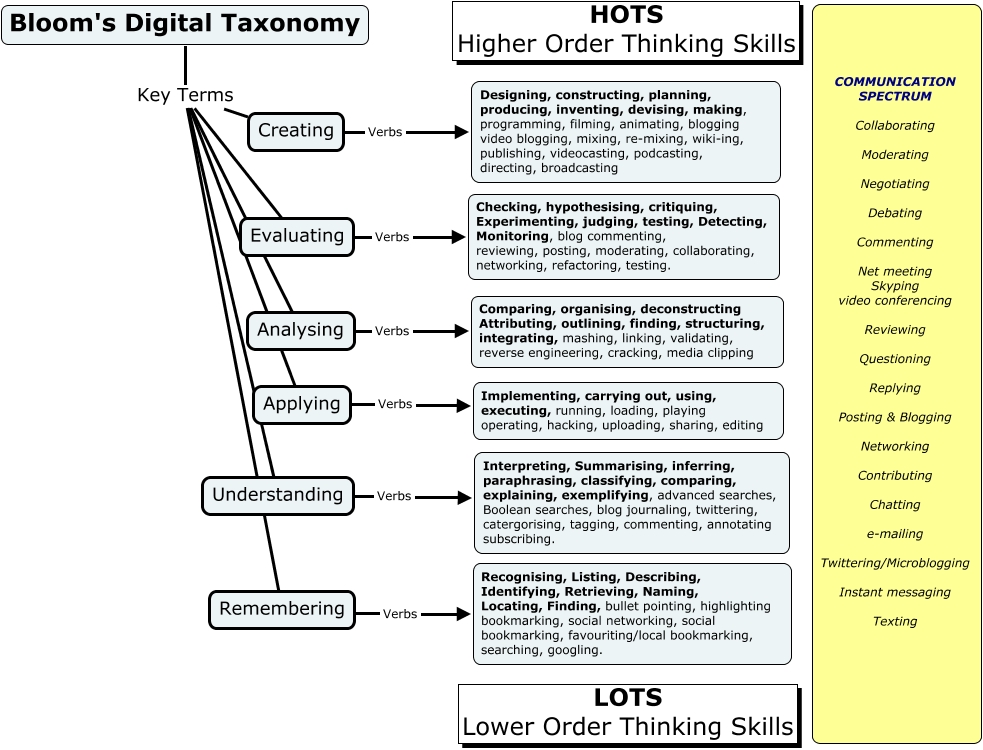
How Blogs Address Blooms Revised Taxonomy
In 2001 Blooms Taxonomy revised was released with the purpose of adding relevance for 21st century students and teachers - format changed from nouns to verbs. How blogs fit in are shown in this illustration.

*click image to see full size
BLOGGING RESOURCES:
ClassPress - Blogging for the Classroom:
http://www.classpress.com/
7 Things You Should Know About Blogs, EDUCAUSE Learning Initiative (2005):
www.educause.edu/ELI/7ThingsYouShouldKnowAboutBlogs/156809
Blogs in Education:
http://awd.cl.uh.edu/blog/
Blogs in Plain English:
www.commoncraft.com/blogs
Classroom 2.0:
www.classroom20.com
Education Blog Directory:
www.blogged.com/directory/education
“Blogging in the Classroom”
http://www.youtube.com/watch?v=cmjrbmazq_k&feature=related
"21st Century Learners"
http://http://www.youtube.com/watch?v=gW_pBLzhpfI
FREE BLOG HOSTS:
Blogger (Google):
www.blogger.com
Blog.com - What's Your Story?:
www.blog.com
Word Press:
www.wordpress.com
Cover It Live:
www.coveritlive.com
EDUCATION BLOG HOSTS:
ClassPress - Blogging for the Classroom:
http://www.classpress.com/
edublog:
www.edublog.com
ePals:
www.epals.com
21Classes:
www.21classes.com
SOURCES:
Heskett, Tracie. Blogging in the Classroom. Westminster, CA: Teacher Created Resources, 2009. Print.

*click image to buy
Solomon, Gwen, and Lynne Schrum. "Blogs." Web 2.0 How-to for Educators. Eugene,Or.: International Society for Technology in Education, 2010. 17-31. Print.

*click image to buy

No comments:
Post a Comment